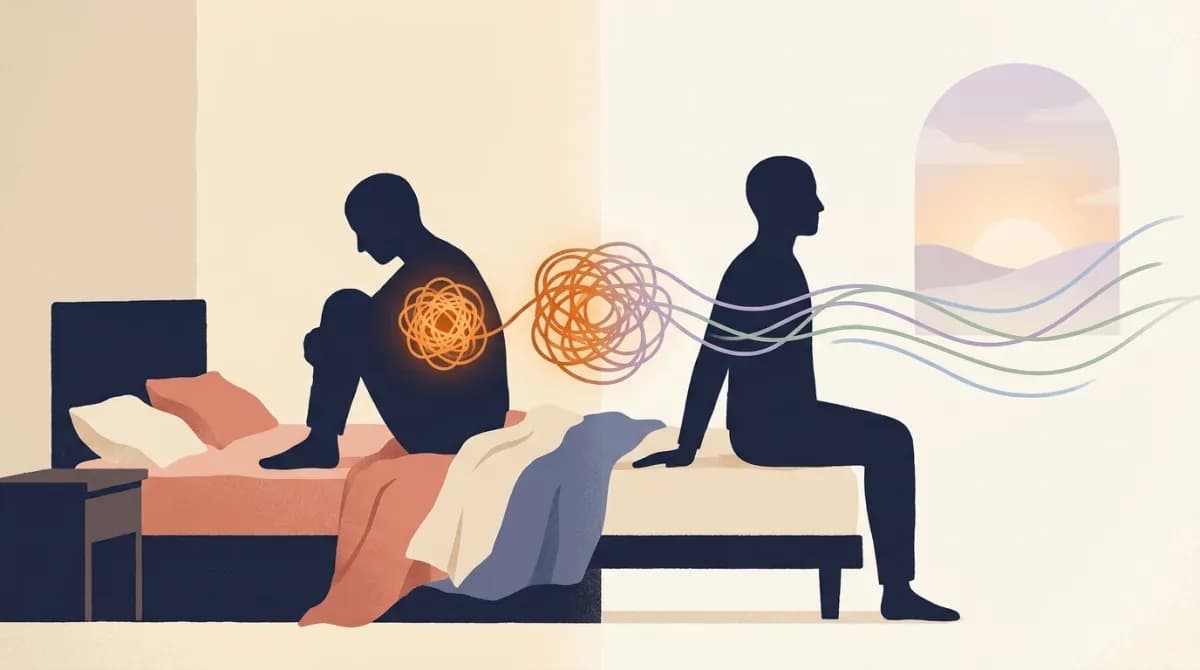
Waking Up With Anxiety: Why It Happens & 7 Ways to Stop It
TL;DR — If you wake up with your heart racing, your mind already worrying, and a knot in your stomach before you've even opened your eyes, you're experiencing morning anxiety — and it's more physiological than you think. In the first 30–45 minutes after waking, your cortisol naturally spikes (this is called the Cortisol Awakening Response). That's normal. But if you're stressed, sleep-deprived, or prone to anxiety, that spike can feel like a panic attack before you've gotten out of bed. The fix is a combination of sleep hygiene, evening wind-down, and protecting the first 30 minutes of your morning. Here's how.
You open your eyes and before you've put your feet on the floor, your chest is tight, your jaw is clenched, and your mind is already running through everything that could go wrong today. You haven't even had coffee. The dread feels physical — stomach knot, shallow breathing, maybe nausea. And the worst part is, there's nothing specific to be anxious about. It's just there, waiting for you.
If that's familiar, you're not crazy, and you're not weak. You're experiencing something sleep researchers call morning anxiety, and it has a specific physiological cause, a set of reliable triggers, and a workable set of fixes. Let's walk through all three.
This is also something we built WakeMind around — the first minute after waking is when morning anxiety gets its grip, and our 4-stage wake sequence is designed specifically to interrupt that moment. More on that below.
Why you wake up anxious: the cortisol awakening response
Here's what's happening in your body between 5:30 and 7:00 AM, whether you're aware of it or not.
In the 30–45 minutes after you wake up, your body produces a sharp spike of cortisol — up to 50% above your baseline levels. This is called the Cortisol Awakening Response (CAR), and it's a normal, documented physiological event that happens to almost everyone. Its job is to pull you out of sleep, kickstart your metabolism, and get you ready for the day.
For most people, CAR is helpful. It's the feeling of "oh, I'm awake now." For people prone to anxiety, it's a physiological cascade that can feel like the onset of a panic attack.
Here's why:
- Cortisol makes your brain more reactive. A spike in cortisol activates your amygdala — the threat-detection center of your brain. If you have any baseline anxiety or unresolved stress, cortisol makes it louder.
- Your prefrontal cortex isn't online yet. The part of your brain that rationalizes, contextualizes, and says "wait, it's not actually that bad" takes a few minutes to fully boot up after sleep. So you experience the amygdala's alarm without the normal dampening.
- Sleep inertia amplifies everything. For the first 15–30 minutes after waking, you're in a cognitively impaired state (sleep researchers call this sleep inertia). Emotions feel bigger. Problems feel unsolvable. See our deep-dive on why you wake up tired after 8 hours of sleep for the full science on sleep inertia. So: a cortisol spike + an online amygdala + an offline prefrontal cortex + sleep inertia = your brain's worst 30 minutes of the day. No wonder it feels awful.
The good news: CAR is designed to resolve itself within 30–45 minutes. The bad news: if you spend those 30 minutes catastrophizing, checking your phone, or replaying yesterday's mistakes, you can reinforce the anxiety and carry it into the entire day.
7 things that make morning anxiety worse
Before we get to fixes, let's identify what might be amplifying the CAR spike beyond the normal range. Morning anxiety is almost always a combination of biology plus behavior. You can't change the biology. You absolutely can change the behavior.
1. Checking your phone in the first 5 minutes
This is the single biggest behavioral amplifier. You're already in a cortisol-amplified, amygdala-reactive state. You then open your email, see a message from your boss, scroll a news headline, or read a notification — and you've just handed your anxious brain exactly the threats it was looking for. The phone is a morning-anxiety accelerant.
2. Caffeine before the CAR spike has resolved
Coffee within the first 30 minutes of waking can compound the cortisol effect. You're already at a cortisol peak; adding caffeine pushes your sympathetic nervous system further into fight-or-flight. If you're anxiety-prone, delaying caffeine by 60–90 minutes after waking is one of the highest-impact changes you can make.
3. Alcohol the night before
Alcohol is a morning-anxiety generator. Even one drink disrupts REM sleep in the second half of the night, causes rebound awakenings (often at 3–4 AM — see our article on why you keep waking up at 3–4 AM), and leaves you with elevated cortisol and lower blood sugar at wake-up. The result: a guaranteed anxious morning. If you're struggling with morning anxiety, this is the easiest variable to isolate.
4. Going to bed on unresolved worries
If you fall asleep while ruminating on tomorrow's presentation, your subconscious keeps working on it. You wake up already engaged with the worry, without ever having consciously chosen to. This is why evening journaling and intention-setting are so effective — they close the open loops before you sleep.
5. Sleep deprivation
Under-sleeping elevates baseline cortisol for the entire next day. A chronically sleep-deprived person is a chronically cortisol-elevated person, and the morning spike lands on top of an already elevated baseline. If you're running on six hours a night, no morning routine will fix your anxiety.
6. Irregular wake times
Circadian irregularity disrupts the normal cortisol rhythm. A wake time that bounces around by 2+ hours from day to day means your body never predicts the CAR correctly, and the spike becomes more disorienting. Keeping a consistent wake time (within ±30 minutes, every day, weekends included) smooths out the morning cortisol curve.
7. A loud alarm
A sudden, loud auditory alarm triggers a startle response, which dumps additional cortisol and adrenaline on top of the CAR. You're essentially being attacked awake. Replace it with a gradual wake-up and you lose one of the biggest contributors to morning anxiety.
7 ways to break the cycle of morning anxiety
Ranked by impact-to-effort ratio.
Tier 1 — Start tomorrow morning
1. Don't check your phone for the first 30 minutes.
This is the single highest-leverage change. Leave your phone in another room. Use a standalone alarm clock or a gentle smart alarm. When your prefrontal cortex is fully online and your cortisol has settled, then check your phone. You will be shocked how much easier mornings feel within 3–5 days.
2. Replace your alarm with a gentle wake sequence.
A loud buzzer is actively causing part of your morning anxiety. A gradual wake — one that ramps up over a few minutes, uses a human-sounding voice, and transitions you out of sleep rather than startling you out of it — doesn't trigger the startle-cortisol cascade.
This is exactly what we built WakeMind's 4-stage wake around: a gentle sound ramps gradually, then a personal voice greeting, then a short positive affirmation, then a contextual briefing with your weather and first task. The sequence is designed specifically to interrupt the morning-anxiety loop before it starts. See how it works.
3. Delay coffee by 60–90 minutes after waking.
Let the natural CAR spike resolve on its own before adding caffeine. This single change dramatically reduces morning anxiety for many people. The trade-off is real but the effect is also real.
Tier 2 — Start this week
4. 4-7-8 breathing, done in bed before you sit up.
Breathe in through your nose for 4 counts, hold for 7 counts, exhale through your mouth for 8 counts. Repeat 4 times. Total duration: about 1 minute. This activates the parasympathetic nervous system and counteracts the sympathetic spike driving your anxiety. The evidence on slow-breathing protocols for acute anxiety is solid.
5. Keep a consistent wake time.
Same time every day, including weekends. Your circadian rhythm anticipates the cortisol release, and a regular schedule smooths the spike. The research on sleep regularity is some of the strongest in sleep science — see the research on our Science page for specifics.
6. Write the worry down, don't rehearse it.
When you wake up and an anxious thought surfaces, instead of mentally running through it, write it down. One sentence, on paper or in a note. The act of externalizing the worry interrupts the rumination loop. You can come back to it later, when your prefrontal cortex is fully online and you can actually do something about it.
Tier 3 — Longer-term fixes
7. Fix sleep quality and quantity first.
If you're under 7 hours of sleep, chronically tired, or have fragmented sleep, no morning routine will fix your anxiety. Sleep debt elevates baseline cortisol, which amplifies the morning spike, which creates more anxiety, which makes it harder to sleep, which worsens the debt. Breaking the cycle starts with the basics:
- Consistent bed and wake times
- No alcohol within 3 hours of bed
- No caffeine after noon
- Cool, dark, silent bedroom (60–67°F, blackout curtains, earplugs or a sound machine — consider green noise if you live in a noisy area)
- Evening wind-down ritual (30 minutes of non-screen time before bed, ideally with journaling) If you're already doing all of these and morning anxiety persists, talk to a doctor.
When to see a professional
Morning anxiety is common and usually responsive to behavioral changes. But there are red flags that suggest something more serious:
- Panic attacks on waking — shortness of breath, chest pain, feeling of impending doom lasting 10+ minutes
- Anxiety that persists all day, not just in the first hour
- Inability to function at work or in relationships because of morning dread
- Thoughts of self-harm or hopelessness
- Anxiety accompanied by chest pain, palpitations, or dizziness (could be thyroid, cardiac, or metabolic, not anxiety)
- Daily panic on waking for weeks on end Any of these warrant a conversation with a primary care doctor or a mental health professional. Generalized anxiety disorder, panic disorder, and major depression can all present with morning anxiety as a primary symptom. They're all treatable. None of them are your fault.
Quick-win protocol: your first morning after reading this
Do these four things starting tomorrow:
- Put your phone in another room tonight. Buy a cheap $10 alarm clock if you have to, or use a gentle smart alarm.
- Set a consistent wake time for the next 7 days. Pick something realistic.
- When you wake up, do 4-7-8 breathing in bed for 1 minute before sitting up. Four breath cycles.
- Delay your first coffee by 60 minutes. A glass of water with a pinch of salt is a fine substitute if you need something to do. Most people notice a real difference by day three. If you don't — if the morning anxiety stays the same or gets worse — go back to the "when to see a professional" section and take it seriously.
Frequently asked questions
Is morning anxiety a sign of depression?
It can be. Morning-worst anxiety (where symptoms are worst in the morning and improve through the day) is a recognized pattern in major depression. It's not diagnostic on its own, but if it comes with low mood, loss of interest in normal activities, disrupted appetite, or hopelessness, talk to a doctor.
Why does my anxiety feel worse in the morning than at night?
Two reasons. First, the cortisol awakening response is real and peaks within 30–45 minutes of waking. Second, your cognitive defenses (the ability to contextualize, reason, and calm yourself) are weakest in the first 30 minutes because your prefrontal cortex is still "booting." The same worry that would feel manageable at 3 PM feels catastrophic at 6 AM.
How long does the cortisol awakening response last?
30–45 minutes on average. Some people experience it for up to an hour. After that, cortisol should return to a normal daytime baseline. If your anxious feeling persists beyond 60–90 minutes, it's probably being maintained by behavior (phone checking, caffeine, rumination) rather than by the CAR itself.
Will breathing exercises really help with morning anxiety?
Yes, for most people, measurably. The evidence on slow-breathing protocols (4-7-8, box breathing, 6 breaths per minute) for acute anxiety reduction is solid. They work by directly activating the parasympathetic nervous system, which counteracts the sympathetic cortisol spike. The key is doing them while still in bed, before you sit up and start thinking about the day.
Can I just take a beta blocker?
Beta blockers (like propranolol) do work for the physical symptoms of anxiety — racing heart, shaky hands. They don't do anything for the cognitive side (ruminating thoughts, catastrophizing). They also don't address the underlying cause. They can be a useful tool in specific situations but they're not a long-term morning-anxiety solution. Talk to a doctor before trying them.
Is it normal to wake up with anxiety every day?
Occasional morning anxiety (once or twice a week) is normal, especially during stressful periods. Daily morning anxiety for weeks or months is not normal and usually indicates one of two things: behavioral amplifiers you haven't addressed yet (phone, caffeine, alcohol, sleep debt), or an underlying anxiety or mood disorder that benefits from professional treatment.
Does waking up at 3 or 4 AM count as morning anxiety?
It's related but different. See our article on why you keep waking up at 3–4 AM — early-morning waking has its own specific causes (cortisol rising too early, blood sugar drops, alcohol rebound) and its own fixes.
The bottom line
Morning anxiety is real, it's physiological, and it's fixable for most people without medication. The biggest variables are behavioral: the first 30 minutes after waking, whether you're reaching for your phone, whether your alarm is startling you awake, whether you're sleep-deprived.
The fix is a combination of three things:
- Protect the first 30 minutes (no phone, no startle alarm, no caffeine)
- Interrupt the cortisol spike with 1 minute of breathwork in bed
- Fix the upstream variables that amplify it (sleep debt, alcohol, caffeine timing, wake time consistency) We built WakeMind specifically around point 1 — the first minute after waking. The 4-stage gentle wake sequence (gradual sound → voice → affirmation → contextual briefing) is designed to interrupt morning anxiety before it has a chance to take hold. If any of this resonates, see how the 4-stage wake works.
Whatever you choose, don't accept mornings that start in dread. They're not who you are. They're a physiological spike and a handful of fixable behaviors. You can absolutely break the cycle.
Related reading
- Why You Wake Up Tired After 8 Hours of Sleep — the sleep inertia explanation
- Why You Keep Waking Up at 3–4 AM — early-morning waking has its own specific causes
- The 5-Minute Morning Stretch Routine That Actually Works — a non-phone thing to do in the first 10 minutes
- What Is Green Noise? — sleep sounds can reduce nighttime waking, which reduces next-day anxiety
- The Science Behind WakeMind — the research on CAR and morning cortisol
Nothing in this article is a substitute for professional medical advice. If your morning anxiety is severe, persistent, or accompanied by physical symptoms, please see a doctor or mental health professional.
Related Articles
Why You Keep Waking Up at 3–4 AM (And What It Actually Means)
Waking up at 3 or 4 AM every night? It's one of the most common sleep complaints — with specific causes. The science, the spiritual questions, and 6 real fixes.
13 min read · Apr 11, 2026

Box Breathing: The 4-4-4-4 Technique Navy SEALs Use (With Diagram)
Box breathing is a 60-second calming technique: inhale 4, hold 4, exhale 4, hold 4. The science, the diagram, when to use it, and how it differs from 4-7-8.
11 min read · Apr 11, 2026