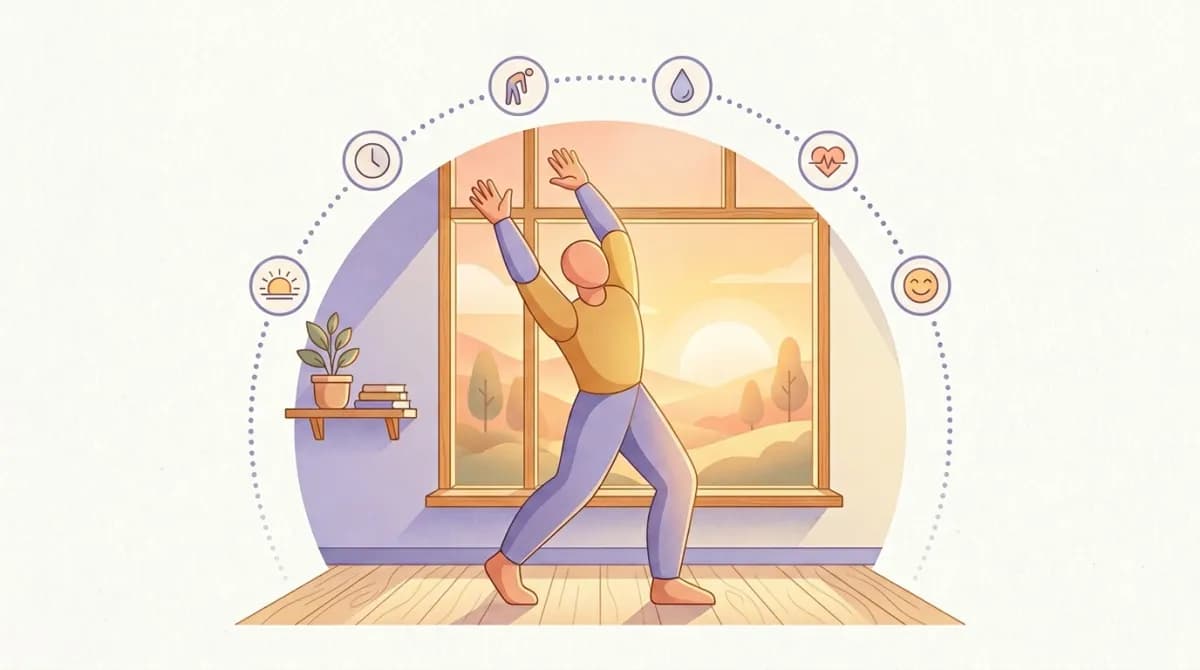
The 5-Minute Morning Stretch Routine That Actually Works
TL;DR — A 5-minute morning stretch routine isn't just good for your back — it's actively helping your nervous system transition from sleep to wakefulness. The reflex you naturally do when you wake up (arching your back, yawning, extending your arms) is called pandiculation, and it's your body's built-in morning activation system. Extend it deliberately for 5 minutes and you'll feel dramatically more alert, reduce morning stiffness, and set your body up for a better day. Here's the exact routine.
You wake up. Before you're even fully conscious, you arch your back, push your arms over your head, and yawn. You do this every morning and you've probably never thought about why. It turns out that reflex — called pandiculation — is one of the most evolutionarily ancient wake-up signals your body has. Dogs do it. Cats do it. Babies do it in the womb. It's how mammals transition from sleep to wakefulness.
Most of us do one quick stretch and then get out of bed. But if you extend that reflex deliberately — five minutes of simple stretches, in bed or on the floor — you're doing something more powerful than just loosening stiff muscles. You're activating your nervous system on its own terms, in the way evolution designed.
This article gives you the full 5-minute routine, in text-only form (no video to pause, no app to open), grounded in the science of why morning stretching works. The routine is designed to be done anywhere, by anyone, including people who haven't done a stretch since high school gym class.
Why we stretch when we wake up: the science of pandiculation
Pandiculation (pan-dick-you-LAY-shun) is the involuntary full-body stretch and yawn combo you do when waking up. You've seen dogs and cats do it. It's not just a random reflex — it's a sophisticated neurological reset.
Here's what pandiculation does:
1. It reactivates muscles that went slack during sleep. During REM sleep, your body is temporarily paralyzed (muscle atonia) so you don't act out your dreams. When you wake up, your muscles need to be consciously recruited back into action. Pandiculation is your brain sending a full-body "everyone back to their posts" signal.
2. It lubricates joints. Synovial fluid (the stuff that lubricates your joints) is less mobile overnight. Stretching pumps it back into circulation.
3. It integrates with the cortisol awakening response. The Cortisol Awakening Response we discuss in our morning anxiety article needs some kind of physical trigger. A deliberate stretch provides it. Done gently, it smooths the spike into a manageable curve instead of letting it land as sudden anxiety.
4. It shifts blood flow to skeletal muscle. Overnight, blood pools more in your core and organs. Stretching redirects it to your arms, legs, and skin — which is part of why you feel warmer and more alert after stretching.
5. It primes your nervous system for proprioception. After hours of being mostly still, your brain needs to re-establish where all your body parts are in space. Stretching is how you reintroduce your brain to your body.
In short: your instinct to stretch when waking up is one of the most biologically important things you can do, and ignoring it (rolling out of bed and straight into your phone) is actively working against millions of years of evolutionary design.
The 5-minute morning stretch routine
Six stretches. Each held for 30–60 seconds. Total time: about 5 minutes. Can be done in bed, on a yoga mat, on your bedroom floor, or even in pajamas on carpet.
Important: Morning muscles are cold. Never force a stretch. The goal is gentle lengthening, not maximum flexibility. If you feel sharp pain, stop. If you feel a soft pull, that's what you want.
1. Full-body extension (in bed) — 30 seconds
What to do: Lie on your back. Stretch your arms straight above your head, reaching for the wall behind you. Simultaneously point your toes away from you, reaching for the opposite wall. Feel the stretch from fingertips to toes. Hold for 30 seconds, breathing slowly.
What it does: Lengthens your entire posterior chain and activates your full body at once. This is the deliberate version of the pandiculation reflex.
2. Knees to chest hug — 45 seconds
What to do: Still lying on your back, draw both knees up to your chest. Wrap your arms around your shins and hug them gently. Feel the stretch in your lower back. Hold for 30 seconds, then gently rock side to side for another 15 seconds.
What it does: Decompresses your lumbar spine after hours of lying flat. Releases lower back tension that accumulates overnight.
3. Supine spinal twist — 45 seconds per side
What to do: Lie on your back with arms extended in a T. Draw your right knee up to your chest, then use your left hand to guide it across your body to the left. Keep both shoulders on the bed or floor. Look to the right. Hold for 45 seconds. Repeat on the other side.
What it does: Mobilizes your thoracic spine, releases tension in your obliques and lower back, and stimulates digestion.
4. Cat-cow (on hands and knees) — 45 seconds
What to do: Get on your hands and knees. Wrists under shoulders, knees under hips. Inhale and arch your back, lifting your chest and tailbone (cow). Exhale and round your back, tucking your chin and tailbone (cat). Move slowly between the two positions, one breath cycle per movement. Do this for 45 seconds.
What it does: Mobilizes your entire spine segment by segment. Also establishes breath-movement coordination, which primes your parasympathetic nervous system.
5. Downward-facing dog or forward fold — 60 seconds
What to do (downward dog): From hands and knees, tuck your toes and lift your hips toward the ceiling. Your body forms an inverted V. Bend your knees as much as you need to — this isn't a flexibility test. Press gently through your palms and lengthen your spine. Hold for 60 seconds.
Or (forward fold, if downward dog is too intense): Stand up, bend at the hips, and let your upper body hang toward the floor. Let your arms dangle. Bend your knees as much as you need. Hold for 60 seconds.
What it does: Stretches your entire posterior chain (calves, hamstrings, back), inverts your head below your heart (increases blood flow to the brain), and fully wakes you up in a way nothing else on this list does.
6. Standing arms-overhead stretch — 45 seconds
What to do: Stand up. Interlace your fingers and press your palms up toward the ceiling. Lift onto the balls of your feet if you're comfortable with balance. Take three deep breaths. Lower your heels, keep your arms up, and gently lean to the right for 15 seconds, then to the left for 15 seconds.
What it does: Final full-body activation. This is the pandiculation reflex in its most deliberate form. You should feel your whole body come online after this one.
Total time: about 5 minutes.
When and where to do it
Best case: On a yoga mat or carpet in your bedroom, immediately after getting out of bed. You're most likely to actually do it if it's the first thing.
Good case: In bed before getting up. The first two stretches are designed for this. Do them in bed, then get up and do the other four on the floor.
Realistic case: Whatever you'll actually do consistently. If that's 3 stretches for 2 minutes, that's better than 6 stretches for 0 minutes because you never got around to it.
Variations
For desk workers
Add a gentle neck roll (slow, small circles in both directions) and a chest opener (stand in a doorway, hands on the frame at shoulder height, step one foot forward, let your chest open). Desk workers accumulate specific tension patterns in the neck and upper back that these two stretches specifically address.
For people over 50
Skip downward-facing dog if it puts pressure on your wrists. Use forward fold instead, with deeply bent knees. Move slower. Hold each stretch for the same duration but transition more gradually. Your joints need more runway to warm up than they did twenty years ago.
For athletes or regular exercisers
This routine is a warm-up, not a workout. Before any morning workout, do this routine first — it preps your nervous system — then follow with a sport-specific dynamic warm-up. Static stretching cold muscles before hard exercise can temporarily reduce power output, but the gentle ROM work in this routine won't hurt performance and will reduce injury risk.
For back pain sufferers
Emphasize the knees-to-chest hug and the supine spinal twist. Skip downward-facing dog if it flares your symptoms. Consult a physical therapist if you have a diagnosed back condition — they can modify this routine for your specific situation.
What to avoid
1. Don't do ballistic stretches (bouncing into a stretch). Cold muscles tear. Every stretch in this routine is static or gentle dynamic.
2. Don't push to maximum flexibility. The goal is gentle lengthening, not PR-setting. Your body will be more flexible 30–60 minutes after waking than at minute one.
3. Don't skip the breath. Each stretch pairs with slow, deliberate breathing. If you're holding your breath, you're defeating the point (parasympathetic activation).
4. Don't do it hungover. Alcohol dehydrates muscle tissue and makes injury much more likely. The same goes for severe sleep deprivation — if you haven't slept, go gently or skip.
5. Don't replace medical treatment with stretching. If you have chronic pain, see a doctor or physical therapist. Stretching helps, but it doesn't fix structural issues.
Why morning stretches matter more than evening stretches
Counterintuitively, morning is the highest-leverage time to stretch — despite your muscles being coldest.
Here's why:
1. It sets the tone for your posture all day. Your movement patterns carry the morning's alignment (or misalignment) throughout the day. Five minutes of stretching at 7 AM pays dividends until 10 PM. Five minutes at 10 PM don't.
2. Morning cortisol helps recruit muscles. The natural CAR spike (see our morning anxiety article) makes muscles more responsive in the first hour of waking. Use that window.
3. You wake up more fully. Stretching is one of the fastest ways to transition from sleep inertia to alertness. See our deep-dive on sleep inertia for why the wake-up moment is so important.
4. It's a keystone habit. People who start their day with a 5-minute stretch routine tend to also eat breakfast, drink water, and feel more in control of their schedule. The mechanism isn't magic — it's that you've made an immediate non-phone decision first thing, which breaks the autopilot pattern.
Frequently asked questions
Do I have to do it in the morning? Can I stretch at night?
You can do both, and both have benefits. But morning stretches are higher-leverage because they set your body up for the day, and because the pandiculation reflex is morning-specific. Night stretching is great for relaxation; morning stretching is great for activation.
How long until I notice a difference?
Most people feel a difference on the first morning — less stiffness, more alertness. The structural benefits (reduced chronic tension, better posture, less back pain) take 2–4 weeks of consistent practice to notice.
I'm not flexible. Is this still for me?
Yes. This routine is designed for stiff, non-flexible, non-athletic people. Every stretch can be modified with bent knees, shorter holds, or reduced range of motion. The point is consistency, not depth. A person who does the routine at 60% intensity every day gets far more benefit than a person who does it at 100% once a week.
I don't have 5 minutes. What's the minimum effective dose?
Two stretches will do it: the knees-to-chest hug (30 seconds) and the standing arms-overhead stretch (30 seconds). One minute total. This covers spine decompression and full-body activation. Not as good as 5 minutes, but dramatically better than zero.
Should I stretch before or after coffee?
Before. Stretching on your first water of the day, without caffeine, gives you a clearer sense of how your body actually feels. Caffeine can mask stiffness. If you need water first, have water. Coffee can wait.
What if I have chronic back pain or an injury?
See a physical therapist before adopting any new routine. Most of these stretches are safe for most people, but specific conditions (herniated discs, spinal stenosis, recent surgeries) require individualized guidance.
Can I do this in bed?
Yes — the first two stretches are specifically designed for bed. The cat-cow and downward dog are harder to do in bed (you need a firm surface), but you can do cat-cow on all fours on top of the covers if your bed is firm enough. The standing stretch obviously requires getting up.
Does morning stretching actually improve sleep?
Indirectly, yes. Better morning routines correlate with better evening wind-downs, and a more activated body early in the day sleeps more deeply at night. The most reliable way to sleep better is to wake up and move. See our full breakdown in why you wake up tired after 8 hours of sleep.
The bottom line
The first 5–10 minutes after waking are the most valuable of your day, and most people waste them on their phones. A 5-minute stretch routine is one of the simplest ways to reclaim that time, activate your nervous system in the way evolution intended, and set your body up for a day that feels better.
The routine is:
- Full-body extension (in bed) — 30 sec
- Knees to chest hug — 45 sec
- Supine spinal twist — 45 sec per side
- Cat-cow — 45 sec
- Downward dog or forward fold — 60 sec
- Standing arms-overhead stretch — 45 sec That's it. No video, no app, no equipment. Do it tomorrow morning and tell us it didn't feel like an upgrade.
We built WakeMind because we believe the first minutes of the day are the most consequential ones. Our 4-stage wake sequence is designed to get you out of sleep gently and into your morning deliberately — exactly the state where a 5-minute stretch routine becomes easy instead of a chore. See how it works.
Related reading
- Why You Wake Up Tired After 8 Hours of Sleep — the sleep inertia science
- Morning Anxiety: Why It Happens and 7 Ways to Stop It — cortisol awakening response deep-dive
- Why You Keep Waking Up at 3–4 AM — the midnight waking pattern
- The Science Behind WakeMind — the 4 pillars of our research approach
Nothing in this article is medical advice. If you have chronic pain or an injury, consult a physical therapist or doctor before starting a new stretching routine.
Related Articles
How to Wake Up Early When You're Not a Morning Person
Waking up early when you're a night owl isn't about discipline — it's circadian biology. The 4 levers that shift your clock, plus a realistic 4-week plan.
7 min read · Jul 29, 2026

50 Things to Be Grateful For Today (Specific Prompts, Not Clichés)
50 specific gratitude prompts organized by category — body, relationships, daily life, small joys, past wins, future hopes, and hard things. Plus the real science.
11 min read · Apr 11, 2026
Morning Meditation: A 10-Minute Beginner's Guide (With Full Script)
The easiest meditation to stick with is morning meditation — and here's why. Full 10-minute beginner script, three styles to choose from, and the science of why morning specifically works.
14 min read · Apr 11, 2026