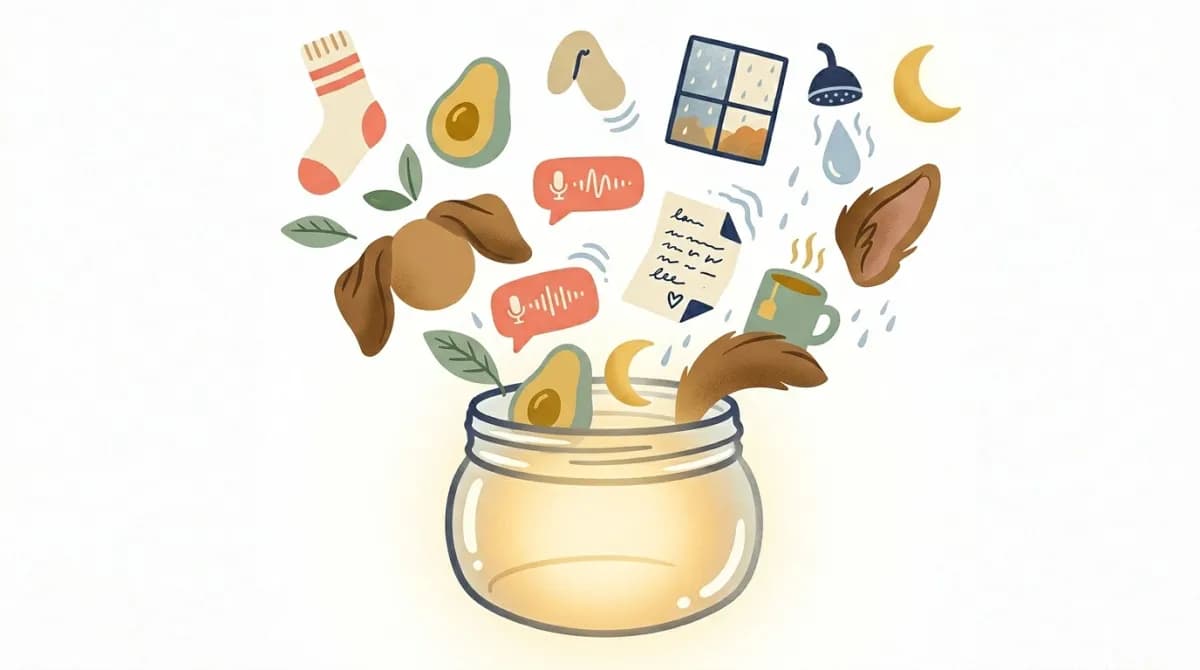
50 Things to Be Grateful For Today (Specific Prompts, Not Clichés)
TL;DR — Gratitude journaling has real science behind it: a 2023 PNAS study found a 6.86% well-being boost from daily gratitude practice. The problem most people hit is running out of things to write about by day 4. This is a prompt list of 50 specific things to be grateful for, organized by category — body, relationships, daily life, small joys, past wins, future hopes, hard things. Plus the science of why gratitude works and how to make it a sustainable habit.
"Just write down 3 things you're grateful for each day." That's the standard advice. It's also why most people quit gratitude journaling within a week.
The problem isn't the practice — it's the prompt. "What am I grateful for?" is too broad. After a few days, you end up with "my family, my health, my job" on repeat until it feels hollow. You stop meaning it. You stop doing it.
The fix is specificity. Instead of "what am I grateful for," ask "what am I grateful for about my morning coffee" or "what was one thing my partner did this week that made me feel loved." Specific gratitude lights up more of your brain, feels more real, and is easier to sustain.
This article gives you:
- A 50-item gratitude prompt list, organized by category
- The actual science of why gratitude works
- Common mistakes that kill the habit
- How to turn this into a sustainable daily practice If you've tried gratitude journaling and quit, this is the list you needed.
The science: why gratitude actually works
Before we get to the list, here's what the research actually shows.
The headline number. A 2023 study in Proceedings of the National Academy of Sciences found a 6.86% improvement in well-being scores from daily gratitude practice. That's a meaningful effect from a minimal intervention — smaller than pharmacological antidepressants, but bigger than you'd expect from "write three sentences."
The mechanism. Gratitude appears to work through at least three pathways:
- Attentional shift. The brain has a built-in negativity bias — it's tuned to notice threats faster than rewards. Gratitude practice deliberately redirects attention toward positive aspects of your life, which over time retrains what you notice automatically.
- Reward circuit activation. Expressing gratitude activates the ventromedial prefrontal cortex and anterior cingulate, which are involved in reward processing. You're essentially strengthening the brain's pathways for noticing good things.
- Social connection. Gratitude practice improves relationships — you become more aware of what people do for you, and you're more likely to acknowledge it. Stronger relationships are one of the strongest predictors of long-term happiness. Earlier foundational research. Emmons and McCullough's 2003 study had participants write gratitude lists for 10 weeks. Results: higher positive affect, better sleep, fewer physical complaints, more exercise, and more optimism. The effect sizes were small-to-moderate but consistent.
The limits. Gratitude isn't a cure for depression or anxiety. It's an adjunct. It works best in combination with other practices (sleep, exercise, social connection, therapy if needed). If you're dealing with serious mental health issues, please see a professional — gratitude journaling alone won't fix it.
How to use this list
Three ways:
1. Daily rotation. Pick one prompt from each category per day. Write 1–2 sentences in response. Takes about 3 minutes.
2. Weekly theme. Pick a category per week. Monday through Sunday, write about different things within that category.
3. Random draw. Close your eyes, point at the list, write about whatever you land on. Good for days when you feel stuck.
The key is specificity. Don't write "I'm grateful for my body." Write "I'm grateful that my body let me sleep deeply last night, the first time in a week." Specific gratitude sticks. Generic gratitude doesn't.
The 50 things
Organized into 7 categories.
Your body (7 prompts)
- A sense your body has right now that's working well (sight, hearing, taste, touch, smell)
- Something your body did for you yesterday that you didn't notice at the time
- A part of your body you've been hard on that deserves acknowledgment
- A physical sensation you enjoyed recently (warmth, a stretch, a deep breath, a hot shower)
- Something your body has healed from that you've forgotten about
- A time your body warned you about something and you listened
- A way your body has changed over the years that you appreciate
Your relationships (8 prompts)
- Someone who made you laugh in the last week
- A person who's been consistently in your corner for years
- A kindness someone showed you recently that you haven't acknowledged yet
- A relationship that's gotten better over time
- Someone who saw you at your worst and didn't leave
- A teacher, mentor, or stranger who changed how you think
- A friend who's also good at being a friend to themselves
- Someone you love who's still alive and close enough to call
Your daily life (8 prompts)
- The first warm drink you'll have tomorrow morning
- A specific piece of music you can listen to whenever you want
- A book you haven't read yet that's waiting for you
- A place you can walk to in under 15 minutes that makes you feel better
- A meal you know how to make and enjoy making
- Something in your home that brings you joy every time you see it
- A small ritual that bookends your day
- The ability to sleep in a bed tonight
Small joys (8 prompts)
- A specific smell you love
- A texture that's satisfying (a soft sweater, smooth stone, rough bark, new paper)
- A sound that immediately relaxes you
- A color or combination of colors that delights you
- A weather condition that makes you happy
- A food that's always worth the money
- A word, phrase, or joke you find unreasonably funny
- A small item you own that makes ordinary moments better (a favorite mug, a good pen, quality headphones)
Past wins (6 prompts)
- A hard thing from 5+ years ago that you survived and are stronger for
- A risk you took that worked out
- A time you helped someone and saw it land
- A skill you have now that past-you would be impressed by
- A relationship or situation you left that improved your life
- A time you were generous when it was hard to be
Future hopes (6 prompts)
- Something coming up this week that you're genuinely looking forward to
- A small goal that feels possible right now
- A plan that exists just because you want it to
- A person you're excited to see soon
- A skill or knowledge you're building that you'll be glad you started
- A trip, project, or experience in the next 6 months you can look forward to
Hard things you're grateful for anyway (7 prompts)
- A setback that redirected you toward something better
- A loss that taught you what matters most
- A criticism that was painful but accurate
- A hard period that made you appreciate easy times more
- A fear you had to face that made you braver
- A relationship that didn't work but shaped who you are
- The fact that you're here, reading this, still trying
How to turn this into a daily habit
The goal isn't to use all 50 at once. It's to build a 3-minute daily practice that's sustainable for years.
The format that works:
- Same time every day (right after waking, right after dinner, or before bed)
- Same place (journal on nightstand, app on your phone)
- One prompt per day, rotating through categories
- 1–3 sentences per prompt
- No performance, no pressure That's it. 3 minutes. Over a year that's about 18 hours of gratitude practice and the equivalent of a full year's worth of positive-focus brain training. The effect accumulates.
If you want to pair it with something else, the highest-leverage combo is:
- Morning: One gratitude prompt + one intention for the day (total: 2–3 minutes)
- Evening: One reflection on the day + tomorrow's intention (total: 2–3 minutes) This is exactly the structure we built into WakeMind's evening wind-down and morning briefing. The full methodology is on our science page. For more on the 3-sentence format, see how to start journaling.
Common mistakes that kill the gratitude habit
1. Writing the same thing every day
"I'm grateful for my family, my health, my job." Day 1: meaningful. Day 7: hollow. Day 14: you've quit. The fix: use specific prompts (like the 50 above) to keep it fresh.
2. Trying to feel grateful instead of noticing gratitude
Gratitude journaling isn't about forcing positive emotions. It's about noticing where gratitude naturally exists. If you have to strain to feel grateful, you're doing it wrong. Just notice — don't perform.
3. Skipping the "hard things" category
Many people think gratitude should only be about pleasant things. The most powerful gratitude is usually about hard things — losses, setbacks, painful lessons. This is where real perspective shifts happen. Don't skip category 7.
4. Using gratitude to avoid real problems
"I'm grateful I still have a job" is not a substitute for addressing a toxic workplace. "I'm grateful my partner is home" is not a substitute for a difficult conversation. Gratitude complements action; it doesn't replace it. If you find yourself journaling instead of dealing with something, that's a signal, not a solution.
5. Making it too big
15 minutes every morning is unsustainable for most people. 3 minutes is. Start small, extend only if it feels natural, never force length.
6. Comparing your list to other people's
Some people write beautiful gratitude entries about the sunset. Some people write "I'm grateful for ibuprofen" and mean it. Both are valid. This is for you, not an audience.
Frequently asked questions
How long until I notice a difference?
Research suggests 2–4 weeks of consistent practice before mood effects become noticeable. The Emmons/McCullough studies found clear effects at 10 weeks. If you're 4 weeks in and feel nothing, something's off with format or frequency — check the "common mistakes" section.
Should I write gratitude in the morning or evening?
Both work. Morning gratitude sets a positive frame for the day. Evening gratitude helps consolidate positive memories and often improves sleep. If you have to pick one, pick evening — the sleep benefit is a bonus.
Is gratitude journaling the same as toxic positivity?
No, if you do it right. Toxic positivity says "only feel good things, suppress the bad." Gratitude journaling says "notice what's working without denying what isn't." The "hard things" category (44–50) is specifically designed to prevent this drift.
Can kids do gratitude journaling?
Yes, and the evidence is strong for it. Use simpler prompts and shorter formats (even 1 sentence per day works). Many schools use gratitude practices as part of social-emotional learning curricula.
What if I genuinely can't think of anything to be grateful for?
Start with your senses. "I'm grateful I can see this page." "I'm grateful for the warmth in this room." "I'm grateful that my body can breathe without me thinking about it." If you're in a dark enough place that even those feel impossible, please talk to a professional — you may be dealing with depression or grief that needs more than journaling.
How does gratitude relate to sleep?
Surprisingly strongly. A 2011 study found that gratitude journaling before bed was associated with better sleep quality, fewer nighttime worries, and longer total sleep time. The mechanism appears to be reduced pre-sleep rumination. See our morning anxiety article for more on the rumination-sleep link.
Is this religious?
No. Gratitude is a practice that exists in most religious traditions, but the psychological effects don't depend on religious belief. Secular gratitude journaling has the same research support.
What should I do if my gratitude journal feels fake?
You're probably writing what you think you should be grateful for instead of what you actually are. Try being more specific and more honest — "I'm grateful my coffee didn't taste burnt today" is better than "I'm grateful for the gift of life" if the latter is just performance.
The bottom line
Gratitude journaling works. The research is solid. The mechanism is understood. The only catch is that most people quit before it can work, because they started with too much or wrote generically.
The fix is specificity, consistency, and realistic scope. Three minutes a day. One prompt. Honest answers.
Use the list above. Rotate through categories. Include the hard things. Don't compare yourself to anyone else's journal. Don't skip days for lack of inspiration. Don't quit because you missed a week.
We built WakeMind around the same principle — small, structured, sustainable daily practices at the moments that matter most (bedtime and wake-up). If you want a gentle morning that includes an affirmation and a morning intention automatically, see how it works. Otherwise, just start with one prompt from this list tomorrow morning.
Related reading
- How to Start Journaling: A Beginner's Morning Guide — the 3-sentence format
- Morning Anxiety: Why It Happens and 7 Ways to Stop It — gratitude as an anxiety intervention
- Why You Wake Up Tired After 8 Hours of Sleep — the sleep–mood feedback loop
- How Sleep Cycles Actually Work — why evening gratitude improves sleep architecture
- The Science Behind WakeMind — the PNAS 2023 study in context
This article is not medical or mental health advice. If you're struggling with depression, anxiety, or grief, please see a professional.