How Sleep Cycles Actually Work (And Why Timing Beats Duration)
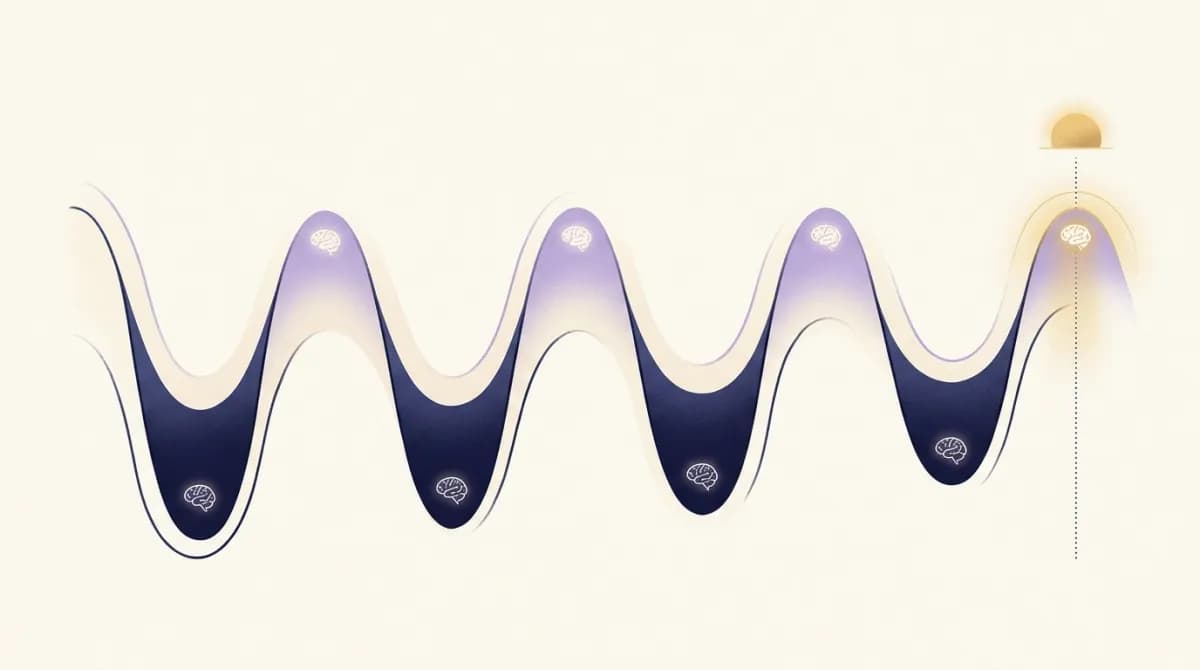
TL;DR — Your brain runs through 4–5 sleep cycles per night, each about 90 minutes. A cycle has 4 stages: N1 (transitional), N2 (light sleep), N3 (deep sleep), and REM (dream sleep). The first half of the night is dominated by deep sleep. The second half shifts toward more REM and light sleep. Understanding this architecture explains why wake timing matters more than total hours — and why generic 8-hour advice misses the point.
Most people think sleep is one long off-state. It isn't. Your brain runs through a remarkably structured sequence of stages all night — and the shape of that sequence matters more for how you feel in the morning than how many hours you logged.
This article walks through:
- The 4 stages of sleep (N1, N2, N3, REM) and what each one does
- What a typical night actually looks like as you move through 4–5 cycles
- How your cycles shift from deep-dominated to REM-dominated through the night
- Why waking in light sleep feels radically different from waking in deep sleep
- What disrupts sleep cycles (alcohol, caffeine, stress, age, apnea)
- How sleep architecture changes across your life
- Whether you can actually "hack" sleep cycles It's the foundational piece that our other sleep articles build on. If you only read one sleep science explainer, this is the one.
The 4 stages of sleep
Sleep is classified into 4 stages, grouped into two categories: Non-REM (N1, N2, N3) and REM.
N1 — transitional sleep (1–5 minutes per cycle)
This is the lightest stage, the transition from wake to sleep. Your muscles relax, your heart rate slows, and you may experience hypnagogic jerks (those sudden feelings of falling). You can be woken from N1 easily, and if woken, you might insist you weren't actually asleep.
N1 only accounts for about 5% of total sleep time. It's a bridge, not a destination.
N2 — light sleep (roughly 45% of total sleep)
N2 is where you spend most of your night. Your body temperature drops, your heart rate continues to slow, and your brain produces distinctive bursts of activity called sleep spindles and K-complexes. Spindles are thought to play a role in memory consolidation and may block external noise (people with dense spindles literally sleep through more).
You can still be woken from N2 relatively easily, though not as easily as N1.
N3 — deep sleep / slow-wave sleep (roughly 15–25% of total sleep)
This is the heavy stuff. N3 is characterized by slow, high-amplitude delta waves. Your body is doing critical work: releasing growth hormone, repairing tissue, consolidating declarative memory (facts and knowledge), and clearing metabolic waste from the brain via the glymphatic system.
Deep sleep is hard to wake from. If someone (or an alarm) pulls you out of N3, you'll experience sleep inertia — that drunk, groggy, cognitively-impaired feeling that can last 15 minutes to over an hour. See our deep-dive on why you wake up tired after 8 hours of sleep for the full science on sleep inertia.
Deep sleep is also concentrated in the first half of the night. If you sleep 8 hours, most of your N3 happens in the first 3–4 hours.
REM — dream sleep (roughly 20–25% of total sleep)
REM stands for Rapid Eye Movement, named for the characteristic eye flickers visible under closed eyelids. Your brain activity during REM is comparable to being awake — sometimes more active. Your muscles, however, are temporarily paralyzed (muscle atonia), which is why you don't physically act out your dreams.
REM is crucial for emotional processing, creativity, and consolidating procedural memory (how to do things). REM deprivation is associated with impaired emotional regulation and reduced learning.
REM is concentrated in the second half of the night. Your first REM period is brief (maybe 10 minutes). Your last REM period can be up to an hour.
A typical night: walking through 4–5 cycles
Here's what a healthy 8-hour night looks like for a typical adult who sleeps 11 PM to 7 AM:
Cycle 1 (11:00 PM – 12:30 AM):
-
N1: 5 minutes — you drift off
-
N2: 15 minutes
-
N3: 45 minutes — heavy deep sleep
-
Back to N2 briefly
-
REM: 10 minutes — first dream period Cycle 2 (12:30 AM – 2:00 AM):
-
N2: 20 minutes
-
N3: 40 minutes — still a lot of deep sleep
-
REM: 15 minutes Cycle 3 (2:00 AM – 3:30 AM):
-
N2: 30 minutes
-
N3: 25 minutes — deep sleep is shrinking
-
REM: 25 minutes — dream periods are getting longer Cycle 4 (3:30 AM – 5:00 AM):
-
N2: 40 minutes
-
N3: 10 minutes — barely any deep sleep now
-
REM: 35 minutes — long REM period Cycle 5 (5:00 AM – 6:30 AM):
-
N2: 45 minutes
-
N3: 0–5 minutes — essentially no deep sleep
-
REM: 40–50 minutes — the longest REM period of the night Notice the pattern: the first half of the night is deep-sleep dominated. The second half is REM dominated. This has huge implications for how you feel when you wake up — and for why cutting sleep short hits different people in different ways.
Why waking in light sleep feels radically different from waking in deep sleep
If your alarm fires at 6:30 AM and pulls you out of light sleep (which is likely if you've been asleep 7+ hours), you'll wake up clear-headed and alert within minutes. If it pulls you out of deep sleep (more likely if you've only been asleep 4–5 hours), you'll feel like you've been hit by a truck — and the grogginess can last an hour or two.
This is why "I slept 8 hours and still feel awful" is so common. It's not about the duration. It's about what stage your alarm caught you in.
The key insight: sleep architecture is consistent. You cycle every ~90 minutes. If you want to wake up feeling good, you want to wake up near the end of a cycle — during N2 or early REM — not during N3.
That's the entire logic behind smart wake-window alarms. See our honest guide to alarm clocks for heavy sleepers for a breakdown of which alarm types actually work with this biology.
What disrupts sleep cycles
Sleep architecture is surprisingly resilient, but there are a few things that consistently break it:
Alcohol suppresses REM in the first half of the night and causes rebound awakenings in the second half. Your deep sleep may feel normal; your REM is gutted. Morning mood suffers badly even after a single drink.
Caffeine reduces total deep sleep and makes sleep more fragmented. The half-life is roughly 5 hours, so afternoon coffee matters more than most people realize.
Sleep deprivation causes "deep sleep pressure" — your body prioritizes N3 at the expense of REM for the next few nights. This is why sleep-deprived people fall into very deep sleep quickly and then have terrible REM rebound with vivid dreams on catch-up nights.
Stress and high cortisol fragment sleep and shift the cortisol curve earlier, which means your cortisol starts rising at 3–4 AM instead of 5–6 AM. This leads to early waking. See why you keep waking up at 3–4 AM for the full mechanism.
Obstructive sleep apnea causes hundreds of micro-arousals per night, disrupting cycle continuity. People with untreated apnea get almost no sustained deep or REM sleep, which is why they're exhausted despite "sleeping 8 hours."
Irregular schedules (social jet lag from late weekends, early weekdays) break your circadian rhythm and lead to misaligned sleep architecture. Your body expects a specific cycle pattern based on habit.
Light exposure at night from phones or alarm clocks suppresses melatonin and delays sleep onset, compressing the night's cycles.
How sleep architecture changes with age
Your sleep cycles aren't static across your life. The rough arc:
- Infants (0–1 year): ~50% of sleep is REM. Cycles are only 50–60 minutes long.
- Children (5–12): Deep sleep dominates. They're remarkably hard to wake in the first few hours of the night.
- Adolescents (13–19): Circadian rhythm shifts later (later bedtime, later wake time). Deep sleep begins to decline.
- Young adults (20–35): Classic 90-minute cycles, ~20% REM, ~20% deep sleep.
- Middle age (35–55): Deep sleep continues to decline. Sleep becomes more fragmented.
- Older adults (55+): Significant reduction in deep sleep. More nighttime wakings. Earlier cortisol rise. Naturally earlier bedtimes and wake times. People over 55 often assume something is wrong because they don't sleep like they did at 25. They're usually just experiencing age-normal architecture changes. Adapt your expectations, not your anxieties.
Can you actually "hack" sleep cycles?
Short answer: not really. The longer answer is that you can work with them.
Things that don't work:
-
Polyphasic sleep (sleeping in short bursts to replace nighttime sleep) — research consistently shows this is cognitively destructive for most people.
-
"Uberman" sleep (6 × 20-minute naps per day) — not sustainable. Most people who try it quit within weeks.
-
Napping to "make up" missed REM — short naps don't include meaningful REM. Longer naps (90+ minutes) might, but they disrupt nighttime sleep. Things that do work:
-
Going to bed and waking up at consistent times so your cycles align with your schedule.
-
Using a wake-window alarm that triggers in light sleep instead of deep sleep. This is the single most actionable application of sleep cycle knowledge.
-
Getting enough total sleep so your architecture can run through 4–5 full cycles without being cut short.
-
Protecting REM by avoiding alcohol and late caffeine.
-
Protecting deep sleep by managing stress, cooling your bedroom, and ruling out sleep apnea. This is exactly what we built WakeMind around. The 4-stage gentle wake sequence (gradual sound → voice → affirmation → briefing) is specifically designed to work with your sleep architecture, not against it. See how it works.
Frequently asked questions
How many sleep cycles do I need?
Most adults need 4–5 full cycles per night, which works out to roughly 6–7.5 hours of quality sleep. The CDC recommends 7–9 hours total (which includes some wake time), so aim for that as your target.
Is it better to sleep in 90-minute increments?
Sort of. The idea is that if you need to cut sleep short, doing so at the end of a cycle (in light sleep) leaves you feeling better than waking mid-cycle (in deep sleep). But actual cycle length varies between 80 and 110 minutes, so the 90-minute rule is approximate. Better to use a wake-window alarm that actually detects your state than to do the math yourself.
What's the minimum amount of sleep I can get away with?
For most adults, below 6 hours is where cognitive performance, mood, and health metrics start to measurably decline. Below 5 hours is where it becomes acutely dangerous (reaction time impairment comparable to legal intoxication). There's no "safe" amount below your actual need — the stories about people thriving on 4 hours are mostly self-reporting bias.
Why do I feel worse after 10 hours than after 7?
Oversleeping pushes you deeper into the second half of your sleep architecture, which has more REM and less deep sleep. You can also end up in very late REM periods right before waking, which contributes to vivid dreams and grogginess. Counterintuitively, less can be more — if you're waking tired after 10 hours, try 8 hours with a consistent wake time.
Do sleep trackers actually measure sleep stages?
Consumer wearables (Apple Watch, Fitbit, Oura) estimate sleep stages based on heart rate variability, movement, and sometimes temperature. They're reasonably accurate for total sleep time and wake periods but less reliable for precisely distinguishing N2, N3, and REM. Treat them as directional, not diagnostic. A clinical polysomnography (PSG) is the gold standard for real measurement.
Does napping mess up my cycles?
A short nap (10–20 minutes) barely touches your nighttime sleep. A long nap (60+ minutes) in the afternoon can reduce your next night's deep sleep by pushing down sleep pressure. If you nap, keep it short and early.
How does jet lag affect sleep cycles?
Jet lag misaligns your internal sleep architecture (which is still on the old time zone) with your environmental schedule (which is on the new one). Your cycles happen at the "wrong" time. It takes about 1 day per time zone to fully resync. Morning light exposure is the most reliable way to accelerate the shift.
The bottom line
Sleep isn't one thing — it's a structured sequence of 4–5 cycles, each moving through N1, N2, N3, and REM. The first half of the night is deep-sleep dominated. The second half is REM dominated. This architecture is why wake timing matters more than total duration, why alcohol wrecks your mornings, why sleep apnea is so devastating, and why smart wake-window alarms actually work.
The key takeaways:
- You can't "skip" deep sleep or REM — you need both.
- Your first few hours are heavy on deep sleep; your last few hours are heavy on REM.
- Waking in light sleep feels dramatically better than waking in deep sleep.
- The biggest disruptors are alcohol, caffeine, stress, irregular schedules, and apnea.
- You can't "hack" sleep cycles — but you can work with them. We built WakeMind around the insight that the wake-up moment matters more than anything else in your morning. If you want to wake up feeling like yourself instead of like roadkill, see how the 4-stage wake works.
Related reading
- Why You Wake Up Tired After 8 Hours of Sleep — the sleep inertia deep-dive
- Why You Keep Waking Up at 3–4 AM — what the architecture looks like in the second half
- Best Alarm Clock for Heavy Sleepers — which alarm types work with your cycles
- Morning Anxiety — the cortisol side of waking
- The Science Behind WakeMind — the 4 pillars of our research approach
Nothing in this article replaces medical advice. If you have chronic insomnia or suspected sleep apnea, see a doctor or sleep specialist.
Related Articles
What Is Core Sleep? Apple Watch Sleep Stages, Explained Honestly
Core sleep is Apple's name for light sleep (N1 + N2) — here's what it does, how much is normal, how accurate the Apple Watch stages are, and what your numbers mean.
6 min read · Jul 29, 2026
Sleep Inertia: Why You Feel Drunk for an Hour After Waking Up
Sleep inertia is why you feel groggy and impaired after waking. The neuroscience, why deep-sleep awakenings are worst, and 8 evidence-based ways to shake it fast.
7 min read · Jul 29, 2026
Do Sunrise Alarm Clocks Work? What the Science Actually Says
Sunrise alarm clocks can cut morning grogginess — here's the dawn-simulation science, who they work for (and who still needs sound), and what to look for.
6 min read · Jul 29, 2026