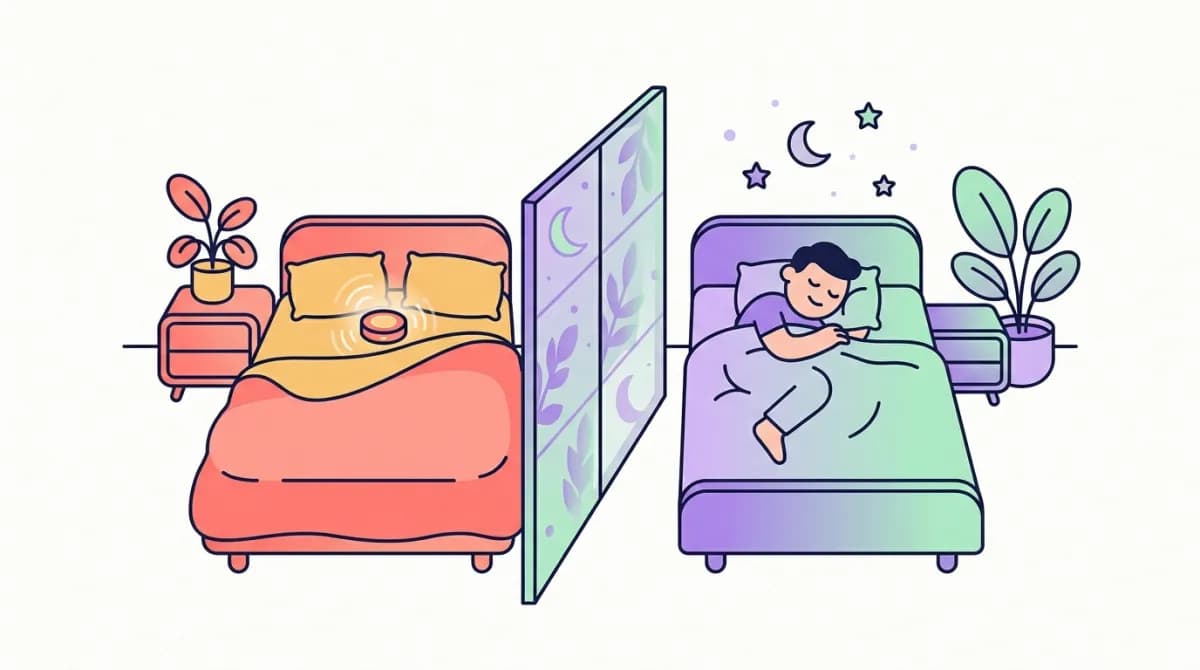
Alarm Clocks for Heavy Sleepers When You Have a Roommate (Or Partner)
Here's a problem with no good search results: you're a heavy sleeper who needs a genuinely loud alarm — and you share a room, a wall, or a bed with someone who is not.
Every alarm clock guide ignores this. They'll happily recommend a 113-decibel bed-shaker siren without mentioning that it will also wake your roommate, your partner, and possibly the upstairs neighbor. So here's the guide for the shared-space problem: what actually wakes a heavy sleeper without waking everyone else, ranked by how well each approach threads that needle.
The core insight: volume is the wrong axis
Loud alarms wake heavy sleepers and everyone within earshot — that's the whole conflict. The way out is to stop relying on sound traveling through the room and switch to alarms that are targeted at your body: vibration under your pillow, light on your face, sound in your ear, or timing that means you need less alarm in the first place. Each option below trades away room-filling volume for something more precise.
Option 1: Vibrating alarms (the roommate favorite)
Bed-shaker alarms — a small puck that goes under your pillow or mattress and vibrates hard enough to rattle you awake — are the standard answer for shared rooms, and for good reason: they're nearly silent to anyone not touching your bed.
- What works: dedicated vibrating alarm clocks (the bed-shaker category exists largely for the deaf and hard-of-hearing community, so it's mature and reliable). Look for adjustable intensity — you want it strong enough to wake you, not so strong it vibrates the bed frame into your partner's spine.
- Phone option: an iPhone under your pillow on vibrate works in a pinch, but the vibration motor is weak for real heavy sleepers, and sleeping on a hard glass rectangle is its own problem.
- Watch option: a smartwatch's haptic alarm is the most targeted alarm that exists — it touches only you, makes zero noise, and the wrist is surprisingly hard to sleep through because the sensation is on you. Many people who sleep through 100 dB sirens wake to a wrist buzz. If one partner wears a watch, this alone can solve the problem.
Option 2: Light-based alarms
A sunrise clock brightens gradually over 20–40 minutes and wakes you through closed eyelids — silently. Your roommate in the top bunk or across the room, facing away with a blanket over their head, often sleeps right through it.
The honest caveat from our deep-dive on sunrise alarm science: at 100–400 lux, light alone is unreliable for true heavy sleepers. In a shared room it works best as the first layer — light to thin out your sleep, then a small targeted alarm (vibration or a quiet tone) to finish the job. Two gentle layers beat one violent one.
Option 3: Personal audio (sound that stays in your ear)
If sound is what reliably wakes you, keep it out of the room:
- Sleep headphones / headband headphones (flat speakers in a fabric band, made for side sleepers) deliver a full-volume alarm that a person two feet away barely registers.
- Regular earbuds work but are uncomfortable overnight and tend to fall out — an alarm playing into your pillowcase wakes nobody.
- Smartwatch audio is too quiet for heavy sleepers; treat watch alarms as vibration devices, not speakers. Note this is one case where you should not follow the usual "charge your phone across the room" advice — that advice exists to fight snoozing, and here it would defeat the purpose.
Option 4: The timing fix (reduce how much alarm you need)
This is the least obvious and most powerful option. Part of what makes you "unwakeable" is being dragged out of deep (N3) sleep, when your arousal threshold is at its peak. Waking from light sleep takes a fraction of the stimulus — a gentle alarm that would never wake you from deep sleep works fine from N2 or REM.
Two ways to exploit this:
- Cycle-aware scheduling: sleep cycles run ~90 minutes, so timing your alarm to land near the end of a cycle (count back from your wake time) gets you closer to light sleep for free.
- A smart alarm that does it for you: WakeMind tracks your night and fires in your lightest stage within a window — which means the alarm itself can be dramatically quieter and still work. For shared rooms, "quieter but perfectly timed" is exactly the combination you're after. It also escalates gradually instead of detonating at full volume, so a light-sleep wake often happens in the first quiet seconds — before your roommate hears anything.
Option 5: Negotiate the environment (the unsexy one)
Sometimes the practical answer is partly social:
- Stagger schedules honestly. If your roommate wakes at 8 and you at 6, a 6 AM alarm is a shared cost — tell them your plan and what you're doing to minimize it. People tolerate far more when they know you're optimizing for them.
- White/brown noise on their side. A brown noise machine near their bed masks your alarm's edge better than it masks yours.
- Earplugs for the light sleeper. Cheap, effective, and worth offering to buy.
- The nuclear option for dorm rooms: swap so the heavy sleeper takes the bed closer to the door/window light — morning light is a free silent alarm.
What to skip
- 113 dB "bomb siren" alarms: they work, but in a shared room they're a declaration of war. Keep them for solo living.
- Snoozing: five snoozes is five alarms for your roommate and worse sleep for you. Snooze fragments sleep without restoring it — one alarm, one wake.
- "Just put the phone on max volume across the room": solves your oversleeping by transferring the problem to someone who didn't consent to it.
Frequently asked questions
What is the best alarm for a heavy sleeper with a roommate?
A vibrating alarm — either a bed-shaker puck under your pillow or a smartwatch's haptic alarm. It targets only your body and is nearly silent to anyone else. Pair it with a sunrise clock or a cycle-timed smart alarm for the most reliable setup.
Do vibrating alarms work for deep sleepers?
Yes, especially bed-shakers with adjustable intensity and smartwatch haptics, which many deep sleepers find impossible to ignore precisely because the stimulus is on their body rather than across the room.
Will a sunrise alarm clock wake my roommate?
Usually not — 100–400 lux is easy to sleep through if you're facing away or under covers, especially with an eye mask. It's one of the most roommate-friendly alarm types, though heavy sleepers shouldn't rely on light alone.
How can I wake up without waking my partner?
Smartwatch vibration is the gold standard for couples: zero noise, physically impossible to share. Second best: sleep-headband headphones with a personal alarm, or a smart alarm that wakes you in light sleep with a quiet tone.
WakeMind wakes you in your lightest sleep stage with a gentle, escalating alarm — quiet enough for your roommate, effective enough for you. Download on the App Store.
Related Articles
Do Sunrise Alarm Clocks Work? What the Science Actually Says
Sunrise alarm clocks can cut morning grogginess — here's the dawn-simulation science, who they work for (and who still needs sound), and what to look for.
6 min read · Jul 29, 2026
Why Is My iPhone Alarm So Quiet? 7 Fixes That Actually Work
iPhone alarm too quiet? It's usually one of 7 settings — Ringer & Alerts volume, Attention Aware, or Bluetooth routing. Every fix, step by step.
8 min read · Jul 29, 2026
How to Change Your Alarm Sound on iPhone (And Which Tones Actually Wake You Up)
How to change your iPhone alarm sound in 4 steps — plus which stock tones science says wake you up fastest, and how to use any song as an alarm.
6 min read · Jul 29, 2026