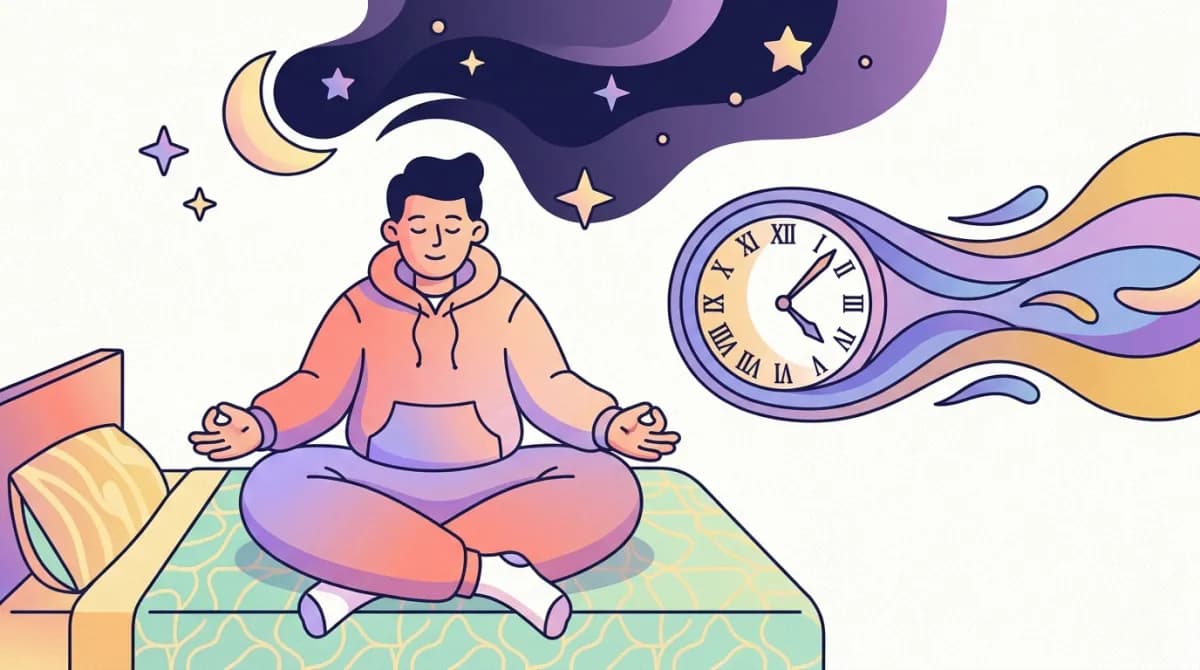
How to Cure Insomnia in 12 Minutes (What the Viral Trick Gets Right — and Wrong)
Let's be upfront: nothing "cures" chronic insomnia in 12 minutes, and any article promising that is lying to you. But the viral claim isn't pulled from nowhere — it's a mangled version of a real military sleep technique that genuinely helps people fall asleep faster, sometimes dramatically so.
Here's what the technique actually is, what it can and can't do, and what to do if your insomnia is the real, recurring kind.
The 12-minute claim, decoded
The viral posts trace back to the "military method" — a relaxation technique described in Lloyd Bud Winter's 1981 book Relax and Win: Championship Performance, developed to help U.S. Navy pilots fall asleep in under two minutes under combat conditions. According to Winter, after six weeks of practice, 96% of pilots could fall asleep in 120 seconds — even in a chair, even with noise.
Somewhere between the book and TikTok, "two minutes of falling asleep after weeks of practice" became "cures insomnia in 12 minutes." The grain of truth: the technique works by systematically shutting down the two things that keep you awake — physical tension and mental chatter. That's a legitimate mechanism, and the method is worth learning.
The military sleep method, step by step
Do this lying in bed, lights out:
- Relax your face completely. Forehead, eyes, jaw, tongue. Let your tongue fall slack in your mouth. The face holds more hidden tension than anywhere else, and releasing it is the signal that starts the cascade.
- Drop your shoulders. Let them sink as low as they'll go, then release your arms one side at a time — upper arm, forearm, hand, fingers.
- Exhale and relax your chest. Breathe out fully and let your chest go heavy.
- Relax your legs. Thighs, calves, ankles, feet — one side, then the other. Feel them sink into the mattress.
- Clear your mind for 10 seconds. This is the hard part. Two approaches from the original method: either imagine one of two static scenes (lying in a canoe on a calm lake staring at the sky; or lying in a black velvet hammock in a pitch-dark room), or repeat the words "don't think, don't think, don't think" for about 10 seconds whenever thoughts intrude. The keys people miss: it's progressive and sequential (rushing it doesn't work), the imagery must be static and boring (no plots, no movement — plots keep you awake), and it took pilots six weeks of practice to hit the two-minute mark. Your first week will be slower. That's normal, not failure.
Why it works (the actual science)
- Progressive muscle relaxation has real evidence. PMR — tensing and releasing muscle groups in sequence — is one of the most-studied insomnia techniques, with meta-analyses showing it reduces sleep-onset time. The military method is essentially PMR in reverse (releasing without tensing first).
- It short-circuits cognitive arousal. Most sleep-onset insomnia is a racing mind, not a broken sleep system. Giving attention a boring, static job (the canoe, the mantra) crowds out rumination — the same principle behind why a short wind-down routine works.
- Slow exhales activate the parasympathetic system. Long, full exhalations are the fastest lever you have on heart rate and arousal. (For a structured version, see our box breathing guide.)
What it can't cure
Chronic insomnia — trouble sleeping three+ nights a week for three+ months — is rarely a relaxation problem. The technique fails when the real driver is:
- Conditioned arousal to your bed. If you've spent months lying awake frustrated, your brain now associates the bed with being awake. No amount of face-relaxing overwrites that association. This needs stimulus control: bed is only for sleep, get up after ~20 minutes of wakefulness, return when sleepy. Boring, counterintuitive, extremely effective.
- A mismatched sleep window. Going to bed before you're sleepy just manufactures lying-awake time. Sleep restriction therapy (temporarily narrowing time-in-bed to build sleep pressure, then expanding) sounds brutal and is the single most effective component of insomnia treatment.
- Untreated underlying issues. Anxiety, depression, sleep apnea, restless legs, chronic pain — treat the cause, not the symptom.
- Bad inputs. Late caffeine, alcohol (it sedates you to sleep then fragments the second half of the night), irregular schedules, bright late-night light. The gold-standard treatment combining these is CBT-I (cognitive behavioral therapy for insomnia) — recommended as the first-line treatment by every major sleep medicine body, ahead of sleeping pills, with durable results after treatment ends. It's available as therapist-led programs and as validated digital programs (some are covered by insurance). If your insomnia is chronic, this is the thing to actually do.
Tonight's realistic protocol
- Military method in bed — expect improvement over 1–2 weeks of practice, not night one
- If awake after ~20 minutes, get up, dim light, do something boring until sleepy, return
- Fixed wake time every day — including weekends; this is the anchor everything else hangs on (here's the full playbook)
- Caffeine cutoff 8–10 hours before bed; no alcohol within 3 hours
- If it's been three months: look into CBT-I, not another hack
Frequently asked questions
What is the 12-minute insomnia cure?
A viral exaggeration of the "military sleep method" — a relaxation technique from a 1981 book that taught Navy pilots to fall asleep in about two minutes after six weeks of practice. It genuinely helps you fall asleep faster; it does not cure chronic insomnia.
Does the military sleep method really work?
The underlying components — progressive muscle relaxation, slow breathing, and static mental imagery — all have research support for reducing sleep-onset time. The specific "96% in two minutes" figure comes from the original book, not a controlled trial. Expect gradual improvement with practice.
What actually cures chronic insomnia?
CBT-I (cognitive behavioral therapy for insomnia) — the first-line treatment recommended over medication by sleep medicine guidelines. Its core tools are stimulus control, sleep restriction, and cognitive restructuring, and its effects persist after treatment ends.
Why can't I fall asleep even when I'm tired?
Usually cognitive arousal (a racing mind), conditioned wakefulness in bed from months of frustrated tossing, or a sleep window that doesn't match your actual sleep pressure. Being tired and being sleepy are different states — insomnia often means high fatigue with high arousal at the wrong times.
WakeMind builds the wind-down into your night and the gentle wake-up into your morning — both ends of better sleep. Download on the App Store.
Related Articles
Alarm Clocks for Heavy Sleepers When You Have a Roommate (Or Partner)
Loud alarms wake your roommate too. The alarms that wake heavy sleepers without waking anyone else: bed-shakers, watch haptics, sleep headphones, light, and timing.
6 min read · Jul 29, 2026
iPhone Sleep Mode Explained: What It Actually Does (And How to Turn It Off)
iPhone Sleep Mode is really three features — Sleep Schedule, Sleep Focus, and Wind Down. What each one does, and how to turn Sleep Mode off temporarily or for good.
6 min read · Jul 29, 2026
Sleep Inertia: Why You Feel Drunk for an Hour After Waking Up
Sleep inertia is why you feel groggy and impaired after waking. The neuroscience, why deep-sleep awakenings are worst, and 8 evidence-based ways to shake it fast.
7 min read · Jul 29, 2026