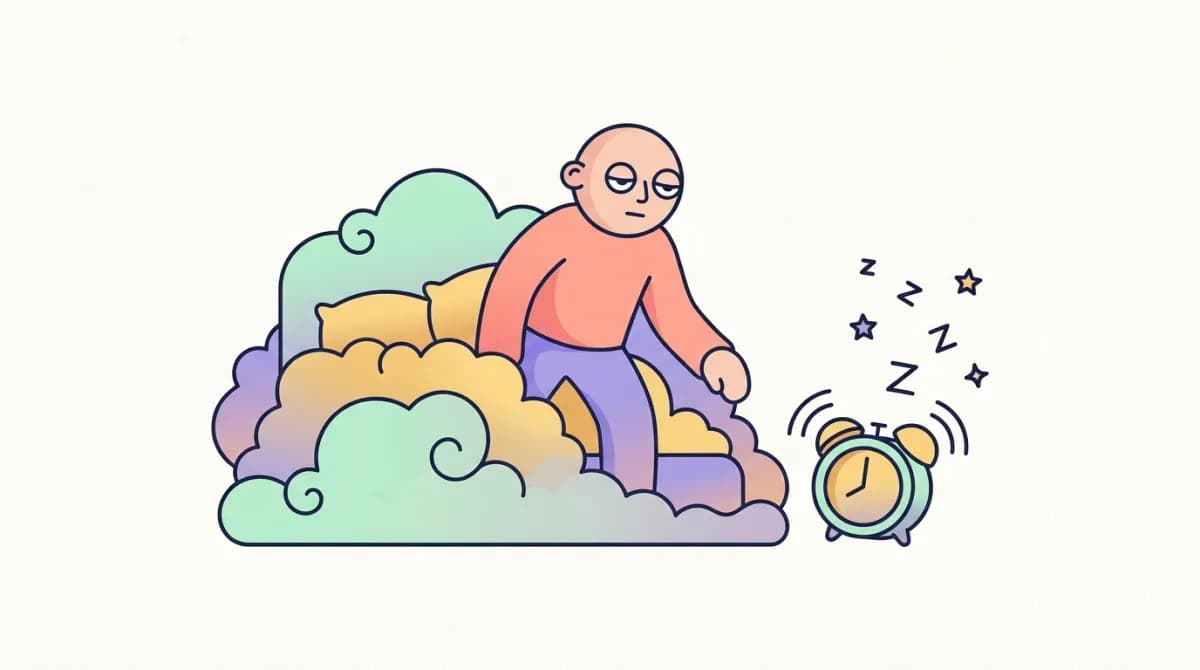
Sleep Inertia: Why You Feel Drunk for an Hour After Waking Up
There's a window every morning — sometimes 10 minutes, sometimes two hours — where you're technically awake but functionally impaired. Your reaction time is worse than if you were legally drunk. Your judgment is off. Simple decisions feel like calculus. You put the milk in the cupboard and the cereal in the fridge.
That state has a name: sleep inertia. And here's the part most articles won't tell you — it's not a character flaw or a sign you "aren't a morning person." It's a measurable neurological process with known causes, and most of those causes are within your control.
What sleep inertia actually is
Sleep inertia is the transitional state between sleep and full wakefulness. When your alarm goes off, different brain regions "boot up" at different speeds — and the prefrontal cortex, the part responsible for decision-making, self-control, and complex thought, is one of the last to come online. EEG studies show that brain activity in the first minutes after waking still carries the slow delta-wave signature of deep sleep, especially in frontal areas.
The subjective result: you're conscious, but the CEO of your brain hasn't shown up to work yet.
The impairment is real and measurable. Research has found that cognitive performance in the first minutes after waking from deep sleep can be worse than performance after a full night of sleep deprivation, and shortfalls in reaction time during severe sleep inertia exceed those at blood alcohol levels of 0.05%. One frequently cited study on naps and performance (Wertz et al.) found decision-making deficits persisted for up to an hour after forced awakenings.
How long does it last?
- Typical: 15–30 minutes
- After waking from deep (N3) sleep: 30–60 minutes
- Severe cases ("sleep drunkenness"): up to 2–4 hours, sometimes with confusion and poor memory of the episode If yours regularly lasts beyond an hour, that's a signal — skip to the "when to worry" section below.
The 4 things that make it worse
Sleep inertia isn't random. Four factors determine how hard it hits:
1. Which sleep stage you wake from. This is the biggest one. Your night runs through repeating sleep cycles of light sleep (N1/N2), deep sleep (N3), and REM. Wake from light sleep or REM and inertia is mild and short. Wake from N3 — when your brain is producing its slowest, most synchronized waves — and you're dragging yourself out of neurological quicksand. This is why the same alarm at 7:00 can feel fine one day and brutal the next: it's not the time, it's the stage.
2. Sleep deprivation. The more sleep debt you carry, the more deep sleep your brain packs into the night (it's called slow-wave rebound), and the harder it resists waking. Chronic short sleepers live in amplified inertia.
3. When in your circadian day you wake. Inertia is worst when you wake at your biological night — which is why 4 AM awakenings feel apocalyptic and why shift workers get hit hardest. If you're regularly waking at 3–4 AM and trying to function, you're fighting two systems at once.
4. How you wake. Abrupt, startling alarms spike adrenaline without clearing the fog. Research from RMIT University found that melodic alarms — tones you could hum — produced significantly less sleep inertia than harsh beeping. The startle response wakes your body; it doesn't wake your brain.
8 ways to shake it faster, in rough order of impact
1. Stop waking yourself in deep sleep. This is the highest-leverage fix and the entire reason smart alarms exist. Sleep cycles run roughly 90 minutes; counting backward from your wake time in 90-minute blocks (plus ~15 minutes to fall asleep) gets you close to a light-sleep window. Apps that track movement and sound do this automatically — more on that below.
2. Get light immediately. Light is the strongest "wake up" signal your biology has. Open the blinds the second you're upright, or use a sunrise clock — dawn simulation measurably reduces sleep inertia. Ten minutes of outdoor morning light beats any hack on this list.
3. Move your body, even badly. You don't need a workout. Two minutes of movement — a short stretch routine works — raises core temperature and heart rate, both of which accelerate the transition. The barrier is starting, which is why the routine should be stupidly small.
4. Use caffeine strategically, not desperately. Caffeine works by blocking adenosine, the molecule creating sleep pressure. A coffee right after waking helps — but the nap researchers found something better: the "coffee nap." Caffeine takes ~20 minutes to absorb, so a quick coffee immediately before a 20-minute nap means you wake just as it kicks in, cutting post-nap inertia dramatically. (Horne & Reyner's classic study found the combination beat either one alone for driver alertness.)
5. Cool water on your face, or a lukewarm-to-cool shower. The temperature shift triggers a mild alertness response. Cold plunges are optional; a splash genuinely helps.
6. Drink water. Overnight you lose roughly half a liter of water to breathing and sweat. Mild dehydration measurably worsens mood and cognition — it's not the main driver of inertia, but it's free to fix.
7. Don't negotiate with the snooze button. Nine-minute snooze fragments return you to the edge of sleep without ever reaching restorative stages — then rip you out again, restarting inertia each time. One alarm, one wake. If you need five alarms to get up, the fix is a better alarm strategy, not more alarms.
8. Keep a consistent wake time, even on weekends. A drifting schedule means your alarm lands at random points in your cycle and circadian rhythm. Consistency lets your body anticipate waking — it starts raising cortisol and temperature before the alarm, which is what "waking up naturally" actually is.
When sleep inertia is a warning sign
See a doctor — ideally a sleep specialist — if any of these are true:
- Grogginess regularly lasts more than 1–2 hours despite 7+ hours of sleep
- You have episodes of "sleep drunkenness" — confusion, slurred speech, or aggressive behavior on waking that you barely remember
- You still feel exhausted after a full night every single day
- A partner reports loud snoring, gasping, or breathing pauses (sleep apnea fragments deep sleep and massively amplifies inertia)
- You're experiencing anxiety or dread on waking alongside the fog — sometimes related, sometimes its own issue Severe, unshakeable inertia is associated with sleep apnea, idiopathic hypersomnia, and delayed sleep phase disorder. All treatable. None fixable with a louder alarm.
The takeaway
Sleep inertia is your brain changing gears, not a moral failing. You can't eliminate it entirely — but you can shrink it from an hour to ten minutes by waking from the right sleep stage, getting light and movement immediately, and not sandbagging yourself with sleep debt.
That first fix — waking from light sleep instead of deep — is exactly what WakeMind was built for. It tracks your night, finds your lightest moment within your wake window, and uses gradually building melodic sounds instead of a startle. You can't always control how much you sleep; you can control which gear your brain is in when the day starts.
Frequently asked questions
What is sleep inertia?
The groggy, cognitively impaired transitional state between sleep and full wakefulness. It typically lasts 15–30 minutes and is worst when you wake from deep (N3) sleep, because the prefrontal cortex is one of the last brain regions to return to waking activity levels.
How long does sleep inertia last?
Usually 15–30 minutes. After waking from deep sleep, 30–60 minutes is common, and severe "sleep drunkenness" episodes can last up to a few hours. Regularly exceeding an hour warrants a conversation with a doctor.
Is sleep inertia dangerous?
The state itself isn't harmful, but the impairment is real — reaction time and judgment in the first minutes after waking can be worse than at 0.05% blood alcohol. Don't make major decisions or drive immediately after a hard awakening.
Does caffeine help sleep inertia?
Yes — caffeine blocks adenosine, the molecule driving sleep pressure. For naps, drinking coffee immediately before a 20-minute nap ("coffee nap") is measurably more effective than caffeine or napping alone.
Why is sleep inertia worse after naps?
Naps longer than ~30 minutes let you descend into deep sleep, and waking from N3 causes the worst inertia. Keep naps at 10–20 minutes, or go a full ~90-minute cycle.
WakeMind wakes you in your lightest sleep stage, so sleep inertia starts small and fades fast. Download on the App Store.
Related Articles
What Is Core Sleep? Apple Watch Sleep Stages, Explained Honestly
Core sleep is Apple's name for light sleep (N1 + N2) — here's what it does, how much is normal, how accurate the Apple Watch stages are, and what your numbers mean.
6 min read · Jul 29, 2026
Do Sunrise Alarm Clocks Work? What the Science Actually Says
Sunrise alarm clocks can cut morning grogginess — here's the dawn-simulation science, who they work for (and who still needs sound), and what to look for.
6 min read · Jul 29, 2026
How to Cure Insomnia in 12 Minutes (What the Viral Trick Gets Right — and Wrong)
The viral 12-minute insomnia cure is a mangled military sleep technique — here's the real method, what it can and can't do, and what actually treats insomnia.
6 min read · Jul 29, 2026