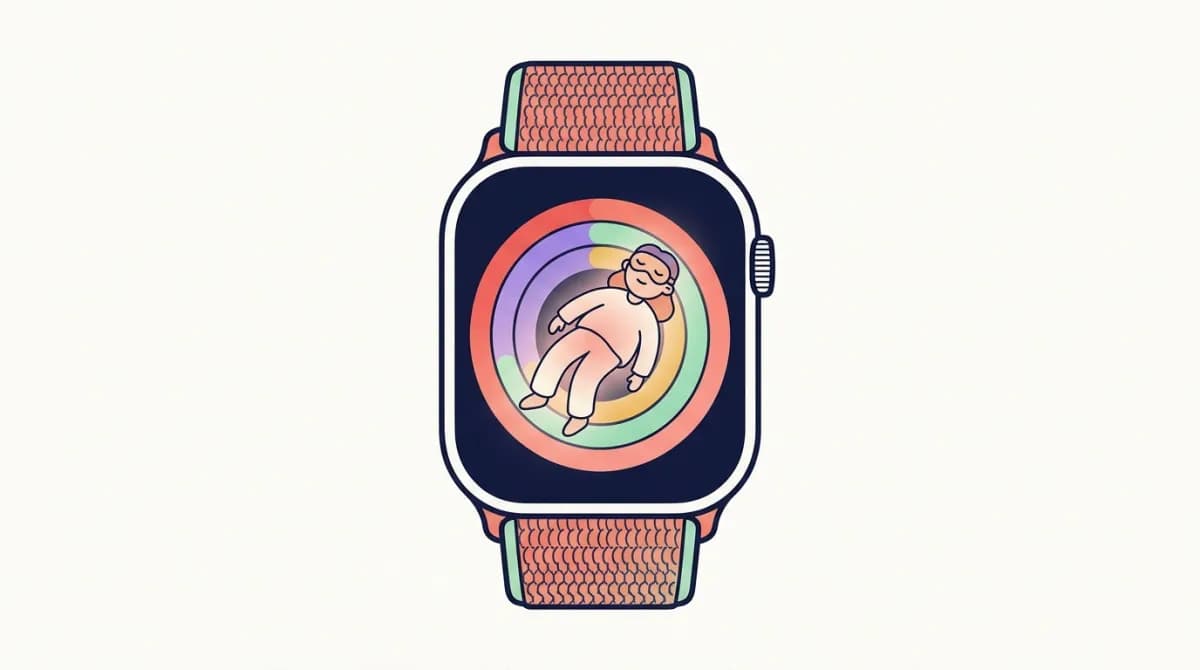
What Is Core Sleep? Apple Watch Sleep Stages, Explained Honestly
You opened the Health app after your first night wearing an Apple Watch to bed, and instead of "light sleep" you got a stage called Core. Now you're here, along with thousands of other people searching the same question every month — because Apple renamed a sleep stage without much explanation.
Here's what Core sleep actually means, what your watch is really measuring (and how much to trust it), and what your numbers are trying to tell you.
The 60-second answer
Core sleep is Apple's name for light sleep — stages N1 and N2 combined. When Apple launched sleep stage tracking, it deliberately avoided the term "light sleep" because people assumed "light" meant "bad" or "useless." It isn't. Core sleep makes up roughly half your night and does essential work. The Apple Watch shows four stages:
- Awake — brief arousals during the night (normal: 2–5% of the night)
- REM — dream-heavy, memory-and-emotion sleep (normal: 20–25%)
- Core — light sleep, N1 + N2 (normal: 45–55%)
- Deep — slow-wave sleep, N3, the physical-restoration stage (normal: 13–23%)
What Core sleep actually does
Light sleep got a PR problem it didn't deserve. N1 is the brief drowsy on-ramp into sleep. N2 — the bulk of "Core" — is where your brain produces sleep spindles and K-complexes: bursts of activity linked to memory consolidation, learning, and keeping you asleep by gating out external noise. N2 also serves as the bridge between deep sleep and REM, which is why it dominates the middle of every sleep cycle.
If your Core percentage is around 50%, that's not a problem to fix. That's the architecture working as designed.
How the stages move through the night
Your night is 4–6 cycles of roughly 90 minutes each:
- Core (light) → 2. Deep → 3. back through Core → 4. REM → repeat The critical pattern: deep sleep concentrates in the first half of the night, REM in the second half. This has two practical consequences:
- Cutting sleep short (sleeping 5.5 hours instead of 7.5) disproportionately amputates REM — the stage tied to emotional regulation and memory.
- Waking during the first half of the night is more likely to catch you in deep sleep, which means savage sleep inertia. Timing your alarm to a Core or REM moment is exactly what smart alarms are for.
How the Apple Watch actually measures this (and its limits)
Your watch doesn't measure sleep directly — it infers it. Using the accelerometer (movement) and the optical heart-rate sensor (heart rate and HRV patterns), a machine-learning model classifies each 30-second epoch into a stage. The gold standard it's approximating — polysomnography — uses scalp EEG, eye movement, and muscle tone electrodes.
Independent validation studies of wrist wearables generally find:
- Detecting sleep vs. wake: quite good (typically 90%+ agreement with lab studies)
- Total sleep time: decent, usually within 15–30 minutes of lab measurement
- Specific stages: imperfect. Agreement on deep vs. REM vs. light often lands around 60–80%. The watch can confidently miss. The honest way to use the data: trust trends over weeks, not single nights. A night showing 8% deep sleep means little. A month where deep sleep dropped from your usual 18% to 10% after you started late-night drinking means a lot.
What your numbers are trying to tell you
Consistently low deep sleep (<10%): check the usual deep-sleep killers first — alcohol within 3 hours of bed, late caffeine, inconsistent schedule, a hot bedroom. Also worth noting: deep sleep naturally declines with age, so comparing your 50-year-old numbers to a 25-year-old influencer's is pointless.
Consistently low REM (<15%): often a total-sleep-time problem (remember, REM lives in the last third of the night), or alcohol/cannabis, both of which suppress REM. Antidepressants commonly reduce REM too — that's known pharmacology, not a watch malfunction.
Lots of "Awake" time: brief awakenings are normal and you won't remember most of them. If awake time exceeds ~10% of the night regularly and you still feel exhausted after 8 hours — especially with snoring or gasping — that's worth screening for sleep apnea.
One warning about the data itself: there's a documented phenomenon researchers call orthosomnia — anxiety caused by sleep tracking that makes your sleep worse. If you find yourself lying awake performing for your watch, take it off for a week. The metric should serve the sleep, not the reverse.
Where the Watch stops — and where apps pick up
The Apple Watch is a decent passive tracker. What it won't do is use your stages to make mornings better: it can't time your alarm to a Core or REM moment instead of blasting you out of Deep sleep. That's the gap WakeMind fills — it reads your night and fires your alarm in your lightest moment within your chosen window, so you wake from the stage where waking is easiest. (If you use Apple's built-in system instead, here's what Sleep Mode actually does under the hood.)
Frequently asked questions
What is Core sleep on Apple Watch?
Core sleep is Apple's name for light sleep — stages N1 and N2 combined. It's the largest stage of the night (normally 45–55%) and supports memory consolidation and stable sleep. Apple avoided the term "light sleep" because users assumed it meant low-quality sleep.
How much Core sleep is normal?
Roughly 45–55% of total sleep. For a 7.5-hour night, that's about 3.5–4 hours. Significantly more or less usually just means deep or REM ran short that night.
Is Core sleep better than deep sleep?
Neither is "better" — they do different jobs. Deep sleep (N3) handles physical restoration, growth hormone release, and immune function; Core/N2 handles memory processing and sleep stability; REM handles emotional processing and procedural memory. You need all three in roughly normal proportions.
How accurate are Apple Watch sleep stages?
Sleep-vs-wake detection is quite accurate (often 90%+ agreement with lab studies); individual stage classification is roughly 60–80% accurate. Use it for multi-week trends, not single-night judgments.
Why did Apple rename light sleep to Core?
To avoid the implication that light sleep is poor-quality sleep. "Core" communicates that this stage is a central, functional part of the night — which it is.
WakeMind uses your sleep stages the way they should be used: waking you in Core or REM instead of deep sleep. Download on the App Store.
Related Articles
Sleep Inertia: Why You Feel Drunk for an Hour After Waking Up
Sleep inertia is why you feel groggy and impaired after waking. The neuroscience, why deep-sleep awakenings are worst, and 8 evidence-based ways to shake it fast.
7 min read · Jul 29, 2026
Do Sunrise Alarm Clocks Work? What the Science Actually Says
Sunrise alarm clocks can cut morning grogginess — here's the dawn-simulation science, who they work for (and who still needs sound), and what to look for.
6 min read · Jul 29, 2026
How to Cure Insomnia in 12 Minutes (What the Viral Trick Gets Right — and Wrong)
The viral 12-minute insomnia cure is a mangled military sleep technique — here's the real method, what it can and can't do, and what actually treats insomnia.
6 min read · Jul 29, 2026